


How do you eat an elephant? One bite at a time.
And which bit do you eat first? The bit right in front of you.
This old proverb reminds us that even the most complex and persistent problems are best tackled in stages. When it comes to poverty and inequality, the scale can feel overwhelming. But progress rarely comes from waiting for perfect solutions or government action alone. It comes from collective action, sustained over time, and rooted in evidence as well as values.
This is why Tees Valley Education and I are publicly supporting the Free School Meals for All campaign and why I’m encouraging others across education, public services, and civil society to do the same.

Hunger is not a side portion in education
Hunger remains one of the most significant barriers to children’s learning, wellbeing, and development. When a child is hungry, research shows that concentration falters. Behaviour changes. Fatigue sets in and learning can become a luxury.
For staff working in schools, hunger is not an abstract concept or problem.
Recent evidence from the Joseph Rowntree Foundation shows poverty deepening and intensifying, with clear intersections between income, food insecurity, and access to basic essentials (JRF, 2026). Research illustrates that the most severe form of poverty, destitution, where people cannot afford to stay warm, dry, clean and fed, more than doubled between 2017 and 2022 (Fitzpatrick et al., 2023). Further datasets show food insecurity rising at alarming speed, with 2.8 million more people experiencing food insecurity between 2021/22 and 2023/24 a 60% increase in just two years.
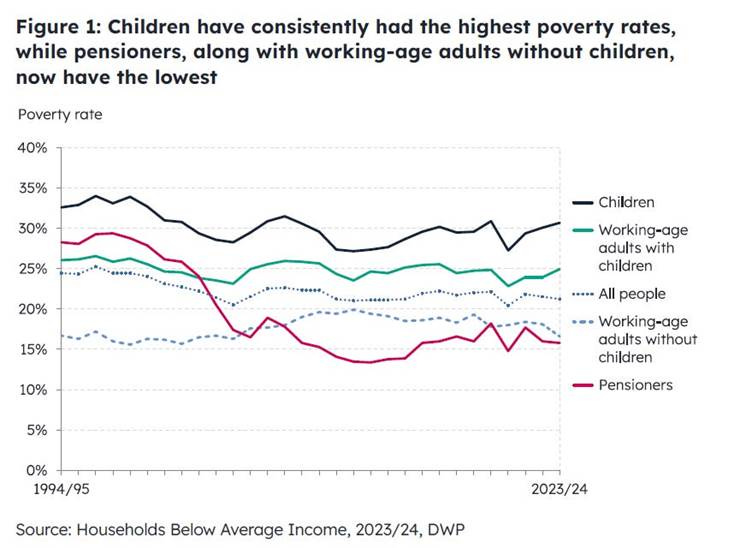
Research also highlights what many educators and support staff working in communities already know. Children, especially those from low-income backgrounds, have been hit hardest by poverty and inequality more than any other groups in society.
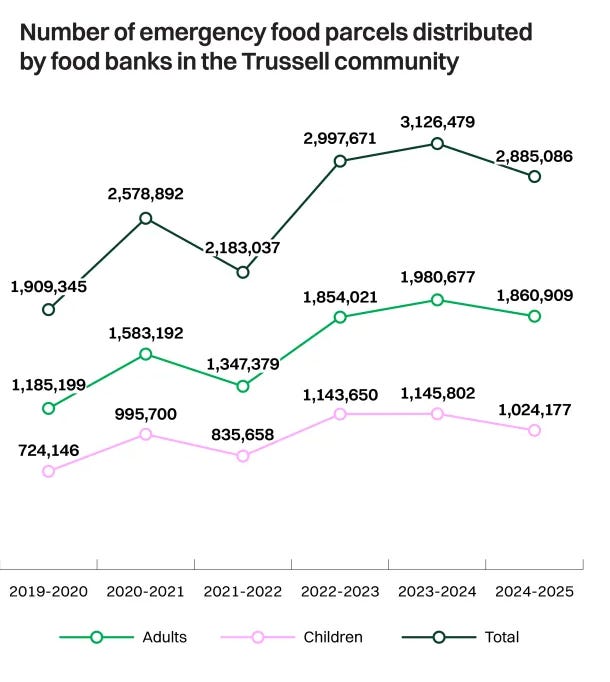
At a local and national level, data from Trussell further highlights the scale of this crisis:
For staff working in schools, hunger is not an abstract concept or problem. It’s visible in empty lunchboxes, attendance patterns, pastoral conversations, and the quiet exhaustion of children who haven’t eaten since the day before. Increasingly, educators and community organisations step in by providing emergency food, stretching already-tight budgets, and carrying the emotional weight of ‘fire fighting’ in systems that appear broken. They do this because it is needed and because it directly impacts what else can be achieved as part of the ‘diet’ of education provided by schools.
That is why Tees Valley Education works alongside organisations such as the Food Foundation, Zarach, and The Sleep Charity. We do not consider food and a good night’s sleep as optional extras in the communities that we serve; they are fundamental conditions for learning. Without them, access to education is constrained before a lesson or educator even begins. All children deserve better.
It is also why I strongly support the National Education Union and its current research with the Alliance for Dignified Food Support, which is gathering evidence from school staff about the practical, emotional, and ethical realities of supporting hungry pupils. This evidence matters. Without it, hunger remains hidden. With it, we strengthen the case for policy change that reflects lived reality rather than rigid eligibility thresholds.
When children arrive at school unable to think because they haven’t eaten, learning suffers.
Food shouldn’t be the elephant in the room
Some recent debate has focused on whether free school meals ‘raise attainment’. For example, the Education Endowment Foundation interim evaluation of the Mayor of London’s universal primary free school meals programme found no immediate attainment gains in the first year, but clear benefits for family finances and reduced stress. That distinction matters.
Expecting a single policy to deliver instant or immediate attainment gains misunderstands both poverty and learning. Hunger is a precondition issue. Feeding children well does not replace good teaching and nor should we push for it to do this, instead I believe it enables it. Reducing stress, stigma, and household pressure creates the conditions in which learning can happen and children can flourish.
There are also legitimate questions and scrutiny about funding. Current per-meal rates , rising to £2.66 in September, fall well below the estimated true cost of provision, which School Food Matters placed at £3.16 per meal in 2024. Schools are already subsidising meals from core budgets. It’s important that educators and other civil architects understand that the campaign to extend free school meals to all isn’t a push to drive more fiscal burdens for schools.
These challenges should strengthen, not weaken, the case for universal provision. They point to the need for coherent, properly funded national policy, not to the idea that some children should continue to miss out. We should be careful not to allow partial evidence or implementation flaws to be used as justification for maintaining a system that excludes too many children from food on the basis of income thresholds alone. That is not a school system, or a society, many of us would advocate as fair.
You can’t teach a child out of hunger
I believe fiercely in education. I believe in great teaching. I believe in schools as powerful civic institutions. It’s why much of my career has been dominated by working in complex school contexts or alongside organisations that exist to strengthen schools and educators. Research also continues to show us that a high standard of teaching in classrooms is still the biggest lever for supporting better educational outcomes for pupils, especially those facing poverty-related barriers to learning (Aaronson et al 2007; EEF 2021; Carpenter et al 2013; Higgins and Major 2019; Riordan 2022).
But we cannot teach a child out of hunger. Too often we hide behind the mental model that simply putting a decent teacher in front of pupils with less is the silver bullet strategy that we need to tackle deep entrenched inequalities. We’ve written more about this in the bestselling book Tackling Poverty and Disadvantage in Schools, a practical guide for school leaders and educators.
When children arrive at school unable to think because they haven’t eaten, learning suffers. When parents are skipping meals to feed their children, engagement with education gives way to survival. These are not failures of schools, school leaders, educators or support staff. They are failures of the system in which schools are asked to operate and serve. Food justice is education justice. Schools have a vital role to play in calling for and calibrating the systems needed to make this happen.



We make this change happen with help from thousands of people just like you.
If you subscribe we can let you know if we're successful with this campaign and the truth is we might not achieve our goal with one action alone.
Will you subscribe so we can keep in touch and work together to win Free School Meals for All?
If you don't want to hear more about this campaign or our work via email close this prompt:
Close