


Across Greater Manchester and Lancashire, I regularly hear from teachers and school leaders about a reality that is becoming increasingly common: children arriving at school hungry.
Staff speak of quietly providing food at the start of the day, of packed lunches being supplemented and of families doing everything they can but finding that rising costs leave impossible gaps. Through the work of our diocesan charity, Caritas Salford, we encounter these experiences every day.
In the Diocese of Salford alone, around 333,000 children are growing up in poverty. Behind that number are children trying to concentrate in lessons while distracted by hunger, families under constant pressure and schools stepping beyond their traditional role simply to ensure children’s basic needs are met.
Research carried out by Caritas Salford found that 80 per cent of leaders in Catholic schools regularly encounter children arriving with little or no food1. When a child is hungry, learning becomes harder, confidence suffers and opportunities begin to narrow. Hunger affects not only educational attainment but also mental wellbeing, physical health and a child’s sense of belonging.
Pope Francis, during his pontificate, reminded us that “the dignity of each human person and the pursuit of the common good ought to shape all economic policies.”
This experience is not unique to Catholic schools, nor limited to our region. Schools across the country are witnessing similar challenges, particularly among families often described as “just about managing”; those whose incomes place them above eligibility thresholds but who nevertheless struggle to meet everyday costs.
As Christians, we cannot ignore this reality. The Gospel consistently reminds us of the special place children hold in the heart of Christ and of our responsibility to care for those who are most vulnerable. Catholic Social Teaching speaks clearly of human dignity and the common good, insisting that economic and social decisions must always place the wellbeing of people first.
Pope Francis, during his pontificate, reminded us that “the dignity of each human person and the pursuit of the common good ought to shape all economic policies.” Ensuring that children are properly nourished during the school day is not simply an act of compassion; it is a matter of justice.
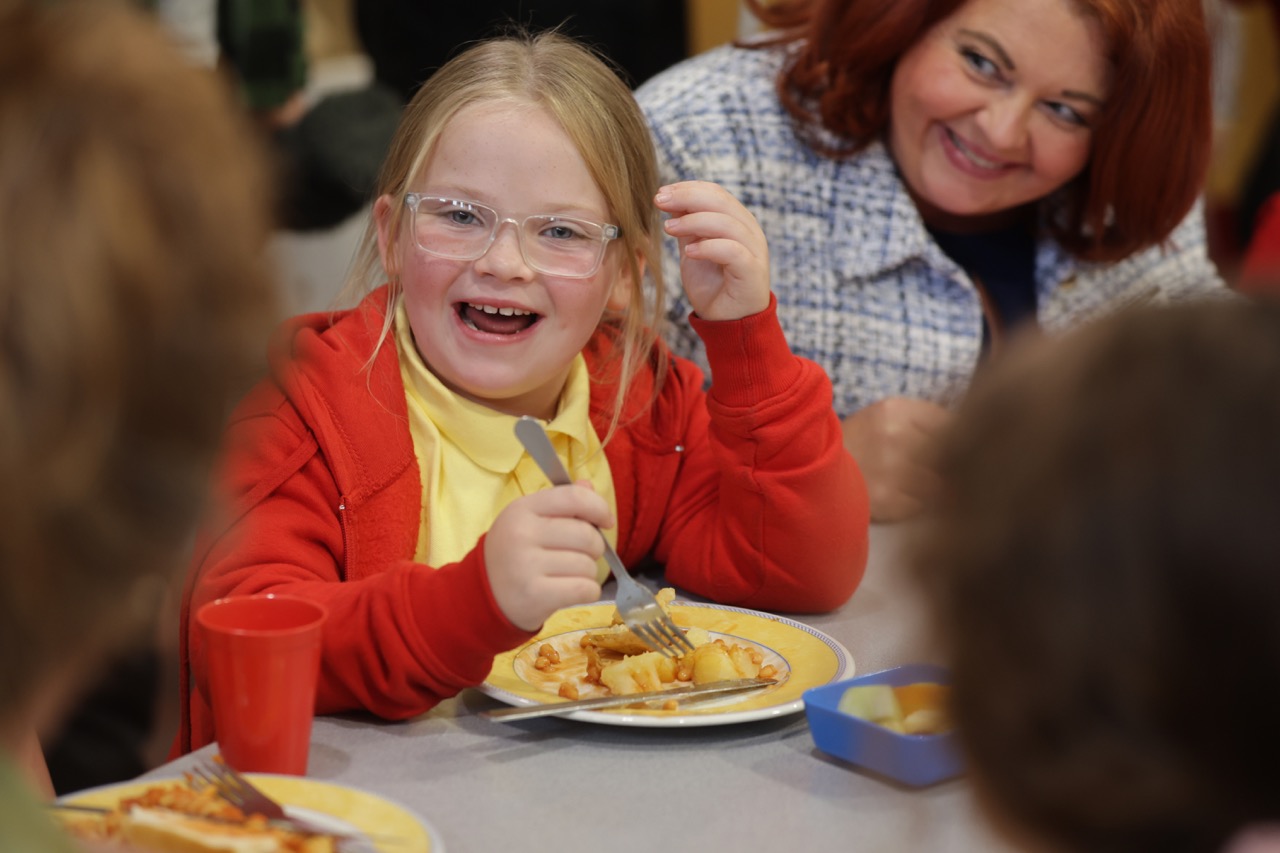
For this reason, the Diocese of Salford and Caritas Salford support the campaign for Free School Meals for All primary school children.
A universal approach recognises a simple truth: children should not have to prove hardship before they can eat. Providing meals for all removes stigma, supports families facing fluctuating financial pressures, and ensures every child begins the school day on equal terms with their peers.
Too often, school leaders tell us about families who fall just outside eligibility criteria yet face genuine hardship. Universal provision would remove these barriers and acknowledge that supporting children’s wellbeing benefits the whole of society.
It would also address one of the most painful aspects of poverty — the sense of embarrassment or exclusion that some children experience. No child should feel singled out in a school dining hall or avoid eating because they fear being identified as different. When meals are shared by all, dignity is protected and community is strengthened.
The word 'Caritas' means love in action. Love in action calls us not only to respond to need when it arises, but also to shape a society where preventable hardship is reduced. Children have no control over the circumstances into which they are born, yet we have the collective ability to ensure they are given the best possible start in life.
Free School Meals for All represents a practical and compassionate step towards that goal. It would support families, strengthen education, improve health outcomes and affirm a fundamental principle: that every child matters equally.
A civilised society should never place children in the position of trying to learn while hungry.
If we are serious about building a society in which every child can flourish, then ensuring that no child goes without a nutritious meal at school must be a shared national priority. Extending free school meals to all primary school children would be a clear and hopeful decision — one that reflects both sound public policy and our deepest moral values.
Every child deserves dignity, opportunity and hope for the future. Ensuring that no child goes hungry at school is one important way we can help make that hope a reality.



We make this change happen with help from thousands of people just like you.
If you subscribe we can let you know if we're successful with this campaign and the truth is we might not achieve our goal with one action alone.
Will you subscribe so we can keep in touch and work together to win Free School Meals for All?
If you don't want to hear more about this campaign or our work via email close this prompt:
Close